|
|
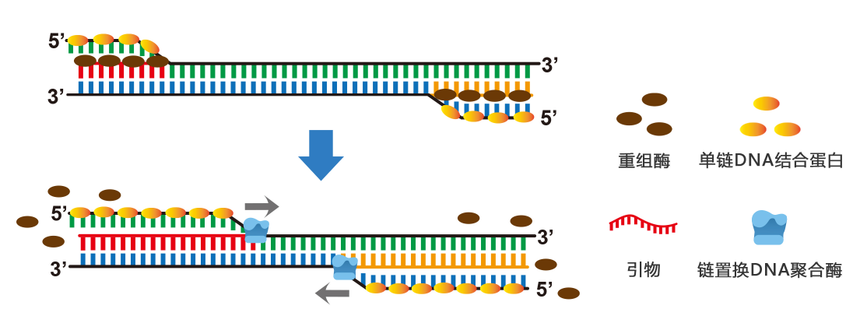
Recombinase Polymerase Amplification (RPA) Technology IntroductionNucleic acid amplification technology is the core support for molecular diagnostics, life science research, and pathogen detection. Traditional PCR technology has become the industry standard for its high sensitivity and specificity, but it is limited by the dependence on precision thermal cycler, long detection cycle, and difficulty in rapid on-site detection, which restricts its application in emergency prevention and control, grassroots screening, field detection, and other scenarios.Recombinase Polymerase Amplification (RPA) as a new generation of isothermal nucleic acid amplification technology, with the advantages of constant temperature rapid, low equipment dependence, and high sensitivity and specificity, breaks through the scenario limitations of traditional amplification technology and becomes a key technical scheme for point-of-care testing (POCT) and rapid on-site diagnosis. 1. The Origin and Core Definition of RPA TechnologyRPA technology was first developed in 2006 by British scientists Olaf Piepenburg and Niall Armes team, relying on the homologous recombination mechanism of phages to achieve nucleic acid amplification outside the body, and the target fragment can be efficiently amplified without the need for temperature rise and fall cycles. As a typical isothermal nucleic acid amplification technology, RPA breaks through the dependence of PCR on thermal cycling, and the reaction can be completed under constant temperature conditions of 37–42℃, close to body temperature, adapted to handheld devices, simple constant temperature devices, or even heat provided by body temperature, truly achieving "away from the laboratory, amplification anytime and anywhere". 2. The core amplification principle of RPA technologyRPA amplification does not require high temperature denaturation, and the double-stranded DNA is melted, primers are combined, and the chain is extended through enzymatic reactions, which can be summarized in five steps: 1.Recombinase-primers complex formation: Recombinase, powered by ATP, binds to primers, forming a stable nucleic acid-protein complex with the ability to recognize and bind to homologous DNA sequences. 2.Homology sequence recognition and strand invasion: The complex scans the double-stranded DNA template, and upon locating the target homologous region, initiates strand invasion, creating a double-stranded DNA structure. 3.SSB:Single-stranded DNA binding proteins rapidly bind the displaced single-stranded DNA, preventing renaturation and degradation, and maintaining template stability. 4.Chain-displacement polymerase extension: After recombination, chain-displacement DNA polymerase binds to the 3’ end of the primer, initiates DNA synthesis based on the single-stranded template, and continues to extend and displace the complementary downstream strand. 5.Exponential amplification cycle: newly synthesized DNA strands serve as templates, and by repeating the above process,微量 target fragments can be amplified to detectable levels within 10–30 minutes, achieving efficient exponential amplification. For RNA samples, only thereverse transcriptase needs to be added to the system to completeRT-RPAin one step, without the need for a separate reverse transcription step, simplifying the operational process. Three, RPA vs PCR vs LAMP Key indicators comparison
IV. Core Advantages of RPA TechnologyCompared to traditional amplification techniques such as PCR and LAMP, RPA offers significant advantages in terms of reaction conditions, speed, device dependence, and applicability: 1.Constant temperature reaction, low equipment dependence: Reaction at 37–42℃ constant temperature is sufficient, no thermal cycler is required, suitable for water bath, constant temperature metal bath, handheld constant temperature device, and even can rely on body temperature to start, suitable for grassroots, field, emergency scene. 2.Ultra-fast amplification, efficient detection: Amplification completed within 10–30 minutes, with results available as quickly as 5 minutes, significantly faster than traditional PCR (1–2 hours), meeting the needs for emergency screening and rapid diagnosis. 3.Ultra-high sensitivity: Can detect1–10 copiesof target nucleic acid, with outstanding detection capability for trace samples (such as throat swabs, blood, food residues), and in some scenarios, it performs better than conventional PCR. 4.High specificity: Primer length 30–35bp, precise recognition by recombinase, extremely low non-specific amplification. 5.Flexible sample and detection format:Compatible with DNA/RNA, adapted for serum, throat swabs, food, environment, animal and plant tissues and other samples; can be matched with fluorescence, lateral flow (paper strip) and other reading methods. 6.Excellent stability of reagents: Can be made into lyophilized reagents, transported and stored at room temperature, getting rid of the cold chain dependence, reducing the cost of detection and the difficulty of operation and maintenance.
5. Mainstream detection methods for RPARPA amplification products can be quickly read out in a variety of ways, adapting to different scenarios: 1.Real-time fluorescence RPA: Fluorescent probes and quenching groups are added to the system, and fluorescence signals are collected in real time during the amplification process, achieving quantitative detection with accuracy approaching qPCR. 2.Lateral flow chromatography RPA (RPA-LFD): Amplification products combined with labeled probes, visually interpreted by a strip test, results in 1–5 minutes, no instruments required, suitable for rapid on-site screening. 3.End-point Fluorescence Detection: The signal is read by a fluorescence reader after the amplification is completed, which is simple to operate, low-cost, and suitable for batch sample screening. 4. Gel Electrophoresis Detection : Traditional nucleic acid electrophoresis to verify amplified fragments, suitable for laboratory-based basic research and method verification. 6. Typical application scenarios of RPA technologyWith the characteristics of rapid, portable and highly sensitive, RPA has been widely used in nucleic acid detection of multiple fields: 1.Fast diagnosis of infectious diseases: Rapid screening of viruses / bacteria such as COVID-19, influenza, dengue, tuberculosis, HIV, hand-foot-mouth disease, etc., on-site rapid detection for emergency epidemic prevention and control. 2.Food safety testing:Fast detection of pathogenic bacteria such as Salmonella, Staphylococcus aureus, Listeria, etc., in meat, aquatic products, dairy products, to ensure food safety. 3.Animal and Plant Quarantine and Seed Security: Animal and livestock diseases, aquatic diseases, plant fungi/bacteria/viruses testing, quarantine at ports of entry and exit, rapid health appraisal of crops in the field. 4.Clinical POCT:point-of-care diagnostics at the bedside, screening in primary care settings, and即时 detection of reproductive and child health and infectious diseases. 5.Environment and Public Health: Source water, soil, air pathogen monitoring, rapid epidemic investigation after disasters. 6.Life Science Research: Gene克隆, mutation detection,微量sample amplification, molecular marker-assisted breeding.
7. The Development of RPA TechnologyTrends1.Multiplexing and Integration:Developing multi-channel RPA to achieve one-tube multi-detection; combining microfluidic chips to construct an integrated sample-in - result-out detection system.2.Low cost and domestic production:Core enzyme proteins and reagents are domestically produced to reduce costs and promote the popularization in grassroots and resource-poor areas.3.Ultra Portable and Intelligent:Combining mobile phone optical detection and AI interpretation, it achieves home self-inspection and remote diagnosis.4.Cross-domain integration application:Expanding to cutting-edge fields such as forensic identification, tumor early screening, drug-resistant gene detection, single-cell analysis, etc.
SummaryRPA technology is characterized byconstant temperature, rapid, sensitive, portable, which has reconstructed the application boundaries of nucleic acid amplification, enabling molecular detection to move from the laboratory to the field, from professional equipment to simple devices, and from centralized detection to immediate screening. In public health emergencies, food safety, animal and plant quarantine, and primary medical care, RPA is becoming a key technology to replace or supplement traditional PCR. With reagent optimization, equipment integration and cost reduction, RPA will further drivepoint-of-care molecular diagnosticsto be more accessible, providing more efficient and inclusive technological support for global disease prevention and control, food safety, and life science research. |